
When we hear about coffee, the first question that comes to mind is, “How was coffee discovered?” And how did people know it was coffee? How did they recognize it? And many more questions blow up our minds. But where to find the right answer?
That’s why I wrote this blog, especially for coffee lovers and anyone who wants to know coffee’s history.
Here, everything is well explained, from the discovery journey to the modern sustainability of coffee.
The Early History of Coffee – 9th Century
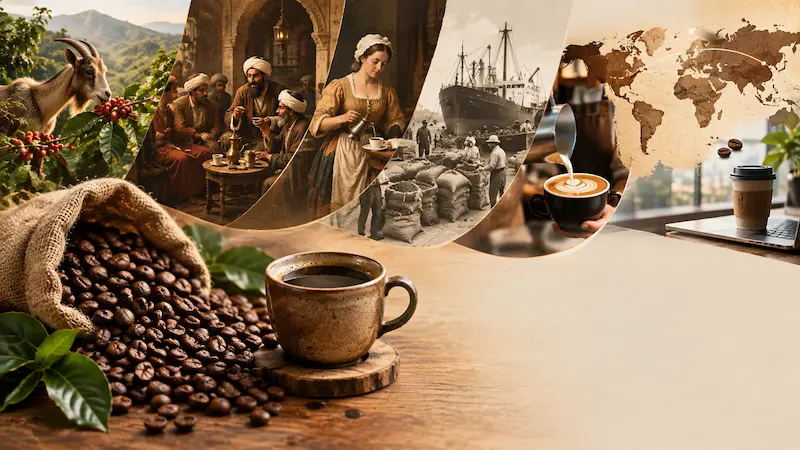
It is believed that an Ethiopian goatherd, Kaldi founded coffee berries in the 9th century. He was taking his goats out to graze. His goats ate red fruit, like berries from a hill. And all the goats suddenly started feeling energetic and jumping. When Kaldi saw this, he plucked out some of the red berries and took them to a saint. He roasted the beans, calling, “It is a poison,” but then discovered it was something special that could help people wake up and make them feel energetic.
15th Century: Ethiopia
The origin of coffee began in Ethiopia. After that, it recognized and cultivated in Yemen. The roots of coffee trace back to Yemen, where it harvested, roasted, and brewed.
In 1554, Sufi communities used coffee to stay awake during nighttime prayers. In the early 16th century, it reached Cairo, Egypt, Damascus, Mecca, and Istanbul.
Coffee culture expanded across the Arabian Peninsula and into the Ottoman Empire. It started to be used as a regular drink and spread between urban society and communities.
16th Century: Coffeehouse Invention
In the middle of the 16th century, coffee houses began to be constructed. Coffee entered Europe in the mid of the 16th century, first in Italy, then middle east regions like Persia, Turkey, and North Africa.
The first coffee house opened in Constantinople, now known as Istanbul. The coffee house was called ‘Qahveh Khaneh’. The coffee become popular for socializing, music, political, and intellectual discussion. It gradually began to spread all over Europe. In America, coffee arrived in the early 1600s, brought by traders and Europeans. More than 66% of adults drink coffee every day. It has become an essential part of their daily routine.
17th Century: Spread all over Europe
In the coming of the 17th century, coffee beans started to spread across the world. Coffee house flourishing across Britain, America, and across Europe – Holland, England, Germany, London, Venice, Paris and Vienna.
London coffee house used to known as “Penny Universities” because it’s expensive price of a cup.
The Dutch became the first Europeans to smuggle and cultivate coffee plants. Plantations were established in Ceylon and Java.
The first time coffee was introduced in India was in the 17th century, when a Sufi Saint named “Baba Budan” carried seven seeds from Yemen in his beard while returning from a pilgrimage. He planted the seeds on the hill of Chikmagalur, Karnataka. It is now known as Baba Budangiri in his honour.
18th Century: World’s Largest Coffee Production
Coffee cultivation expanded globally through colonialism. French brought coffee to the Caribbean and South America.
One of the earliest cultivations of coffee in the New World was when Gabriel de Clieu brought coffee seedlings to Martinique in 1720, from where it spread from saint- Domingue & city like Mexico.
By 1788, Saint- Domingue supplied half of the world’s coffee. Brazil began cultivating it and eventually dominated global production. By 1852, Brazil became the world’s largest producer of coffee and has held that status ever since.
Since 1950, other producers emerged like Colombia, Ivory Coast, Ethiopia, and Vietnam. And Colombia became the second-largest producer in 1999. Thus, coffee spread across the nation.
19th Century: First Espresso Machine
The invention of coffee gained even more momentum. It expanded in other countries too. The technologies and innovations of coffee came to be studied. The first espresso machine invented in Italy named as “Angelo Moriondo”. It helped improve roasting and brewing.
Coffee became a global commodity crop tied to Colonial economies in Latin America, Africa, and Asia.
20th Century: Major Coffee Brands Emerged
In the 20th century, instant coffee invented, with mass production of soluble coffee crystals taking off during World War II. The soldiers used it to stay awake during the war.
After that, major coffee brands emerged like Folgers, Maxwell House, and Nescafé. This is also known as the second wave of coffee, when brands like Starbucks emerged. Coffee became a lifestyle product, and its culture spread globally.
History of Coffee in the 21st Century
The third wave of coffee emerged in the 21st century as it rapidly spread across the world, especially through beans. Coffee import-export, direct trade, and single-origin sourcing expanded further. Its roasting and brewing methods, such as pour-over and cold brew, invented.
Coffee most traded commodities in the world. It is playing a major role in the economy as well. In various places, cafes began to spread. Coffee started to become available in grocery stores and shops. People were doing experiments with new types of coffee, with its taste, flavour, and style. Today, coffee has become a daily part of the routine for most of the people.
For more such amazing blogs about coffee, visit CoffeewithPreeti.