
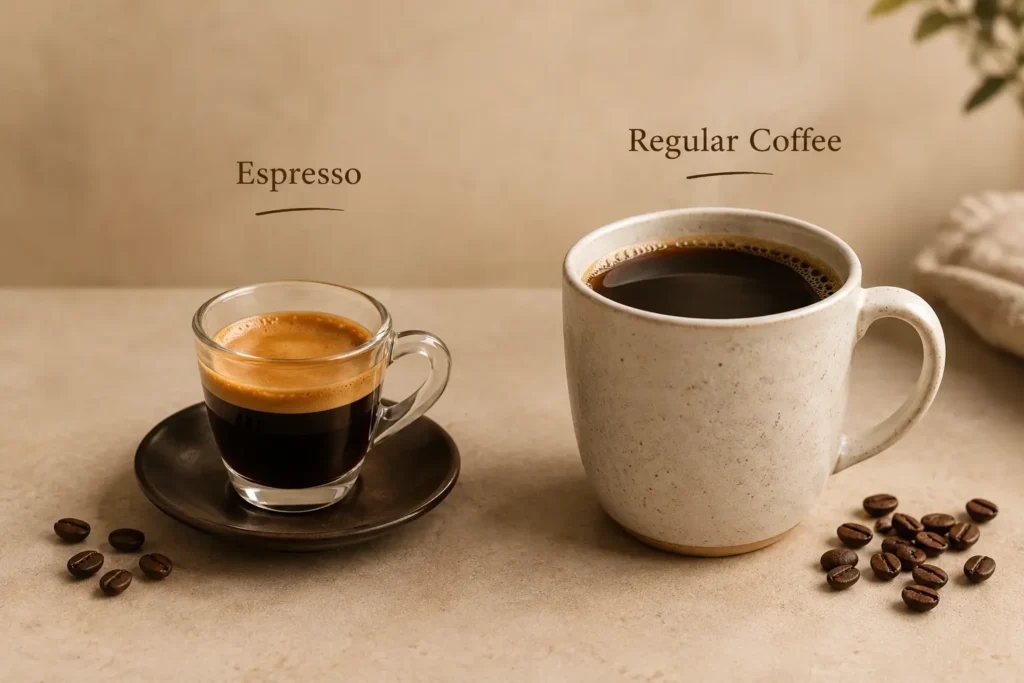
Espresso and Regular coffee are both the base of most coffee drinks. They have some distinct differences from each other. But both play unique roles in making a strong beverage.
Below, I have explained this in a detailed article. You can read it here and enjoy.
What is Espresso?
Espresso is often called ‘a shot’ made under pressure of hot water through finely ground beans.
The pressure is usually set to under 9 bars for a short duration of 25-30 seconds.
It creates a thick, strong beverage shot for use in most of the drinks, like cappuccino, americano, macchiato, and flat white.
The word espresso comes from Italian and means ‘pressed out’ by hot water forced through tight coffee grounds.
What is a Regular Coffee?
Usually, regular coffee refers to a caffeinated brewed coffee, such as drip, pour-over, or filter coffee. In this, hot water passes without pressure for several minutes. It is made from real roasted coffee beans with a smooth, balanced, bitter, and complex taste. It is mostly used for instant coffee or packaged coffee.
Origin of Espresso & Regular Coffee
Basically, the origin of espresso is considered to be in Italy in the 19th century. It is assumed that Angelo Moriondo patented the first espresso machine in 1884. It combined hot steam water with high pressure to brew coffee. In 1901, Luigi Bezzera created a single-serving portafilter that reduced brewing time. After that, in 1905, Desiderio Pavoni invented a water pressure valve and other components, and Desiderio and Luigi successfully sold their first espresso machine at the Milan fair.
On the other hand, regular coffee has crossed thousands of years and spread across the entire world. Its roots trace back to East Africa and the Arabian Peninsula in ancient forests.
Flavour and Taste
Espresso is a mix of hot water and ground beans. It gives intense, strong, bold, balanced bitterness and acidity, with a creamy texture and flavour.
Regular coffee has sweet, acidic, and bitter flavours, with a crema or strong aroma. It uses around a 1:16 ratio of concentrate, which mellows its flavour. And that makes it a little less bitter than espresso.
How Much Caffeine Does Espresso Contain?
After researching caffeine from various platforms, it is estimated that one shot of espresso contains around 60 to 75 milligrams of caffeine. And with a double shot, it contains around 125- 150 milligrams of caffeine.
But coffee beans also play a major role (As Robusta will extract more caffeine than Arabica)
It also depends on the ground dose, size of beans, temperature, extraction time, and grind time. They all play a role in the caffeine amount.
A regular coffee contains around 90- 95 mg of caffeine in an 8-ounce regular brewed cup. It is based on a standard baseline. And a typical coffee mug (12oz) contains more than 110- 250 milligrams of caffeine.
Estimate Parameters to Get Perfect Espresso at Home
Brewing Volume- 25ml
Water Temperature- 92-105℃
Extraction Pressure- around 9bar
Extraction Time- 25-30 seconds
Coffee Dose- 6.5-7.5g for a single shot
Grind – It influences how quickly caffeine is extracted. With a fine grind, you can have a perfect mix of rich, sweet, thick and balanced flavour. Regular coffee requires a coarser grind.
It is experimented that the longer the hot water makes contact with coffee grounds, the more caffeine is extracted from it.
Coffee Beans for Espresso & Regular Coffee
There isn’t any specific type of coffee beans that you have to use, but roasted, original, and fine-ground coffee beans can give the best espresso shot.
You can use:
1- Arabica beans offer a wide range of complex, sweet, smooth, and pleasant flavours.
2- Robusta beans offer a richer, bolder, bitter, woody taste than Arabica. They have double the caffeine and less sugar than Arabica beans.
3- Medium to Dark Roasts- These types of beans are considered the most suitable for espresso, with rich oils, deep, chocolate notes, and caramel sugars.
4- Light Roasts- Often create a light, highly acidic, sour taste. They are sometimes harder to brew if your espresso machine won’t pressurise at high temperatures.
5- Espresso blends are mostly recommended for beginners. They are a mix of different types of beans from different regions (Latin American Arabica, Indian, and African Robusta). Best used for Lattes and Cappucino.
6- Single-Origin Beans
These types of beans are grown and come from a specific farm or region. Estate beans are a specific type of single-origin beans.
Arabica Beans are considered the most suitable beans for brewing regular coffee. They create a smooth, sweeter, and balanced flavour in your regular coffee.
Health Benefits of Having Espresso
These are the researched bullet points I have used here. Easy to read, remember, and understand.
- Help in Strengthening Long-Term Memory
- Make You Stay Concentrated & Active
- Build Up Physical Activities
- Enhance Digestion
- Filled with Antioxidants
- Low in Calories & Weight Loss Effective
- Live with Lower Risk of Stroke
- Low Risk of Diabetes
- Support Metabolism
- Brighted Your Mood
As research says, more than 4-5 daily cups of espresso can lead to side effects such as an unfocused mind and sleepless nights. Consume only in moderation so that you can enjoy the taste of espresso every day.
In this blog, I only added bullet points of health benefits, but if you want to know the details of each benefit according to doctors and science. You can read my blog “Health Benefits Of Having Coffee”.
Equipment Required for Espresso & Regular Coffee
To make a good espresso, you will need an espresso machine to build up pressure on the water. There are various types of espresso machines available on the market, such as semi-automatic, built-in grinder, and super-automatic, also called a one-touch machine.
Choosing an espresso machine completely depends on whether you are looking for handmade, barista-style espresso or brewed with a one-touch button for a quick shot.
Regular coffee requires a simple dripper, French press, or filter machine. It is much cheaper than an espresso machine and easy to brew. Read more about coffee on coffeewithpreeti